Tag: authentication
-

What is authentication assurance? What is authentication assurance level 3? The NIST is on version 3 of the Authentication Assurance levels, called Authentication Assurance Level 3 (AAL3). Authentication Assurance relies on examination of the cryptographic modules of an authenticator. Level 3 requirements (AAL3) means that the code is within a tamper-proof container so that keys used in the cryptography are destroyed […] Read more -
Yubico Authenticator Hardware-backed security Add your credential to the YubiKey with touch or NFC-enabled tap. Hardware-backed strong two-factor authentication raises the bar for security while delivering the convenience of an authenticator app. Users can also experience greater convenience by unlocking their YubiKey with FaceID or TouchID. And, users can use smart card certificates stored on the YubiKey […] Read more -
What is OATH – TOTP (Time)? What is OATH? Open Authentication (OATH) is an initiative addressing challenges making standard, open technology available to all. Learn more about OATH How to use OATH with the YubiKey? When using OATH with a YubiKey, the shared secrets are stored and processed in the YubiKey’s secure element. This has two advantages over storing secrets on […] Read more -
What is a Man-in-the-Middle (MiTM) Attack? What is the goal of a Man-in-the-Middle attack? The goal of these attacks are to steal personal user information. Examples are usernames and passwords, credit card information, or account details. Attackers then use obtained information to access account information, change login credentials, or initiate unapproved fund transfers. How do I prevent Man-in-the-Middle attacks? Security keys […] Read more -
What is a YubiKey? The authentication challenge Our mission is making secure login easy and available for everyone. Balancing security and usability has always been a challenge. And the more secure hardware authentication solutions are difficult to use and deploy. The YubiKey changes this. Read more -
What are Biometrics? How do Biometrics work in a security key? Biometrics are biological measurements or physical characteristics. Once biometric data is obtained, like in a security key or example, it is then saved so it can be used for the future to authenticate into a device or application. Biometric fingerprint credentials are stored in the secure element that helps […] Read more -
What is the FIDO Alliance? What is the mission of the FIDO Alliance? •Developing technical specifications that define an open, scalable, interoperable set of mechanisms that reduce the reliance on passwords to authenticate users •Operating industry certification programs to help ensure successful worldwide adoption of the specifications •Submitting mature technical specification(s) to recognized standards development organization(s) for formal standardization Who […] Read more -
Web Authentication How does WebAuthn work? WebAuthn is an API that makes it very easy for a relying party, such as a web service, to integrate strong authentication into applications using support built in to all leading browsers and platforms. This means that web services can now easily offer their users strong authentication with a choice of […] Read more -
Two-factor authentication (2FA) An example of two-factor authentication A good example of two-factor authentication is the withdrawing of money from an ATM; only the correct combination of a bank card (something that the user possesses) and a PIN (something that the user knows) allows the transaction to be carried out. The problem with passwords Passwords are easily breached […] Read more -
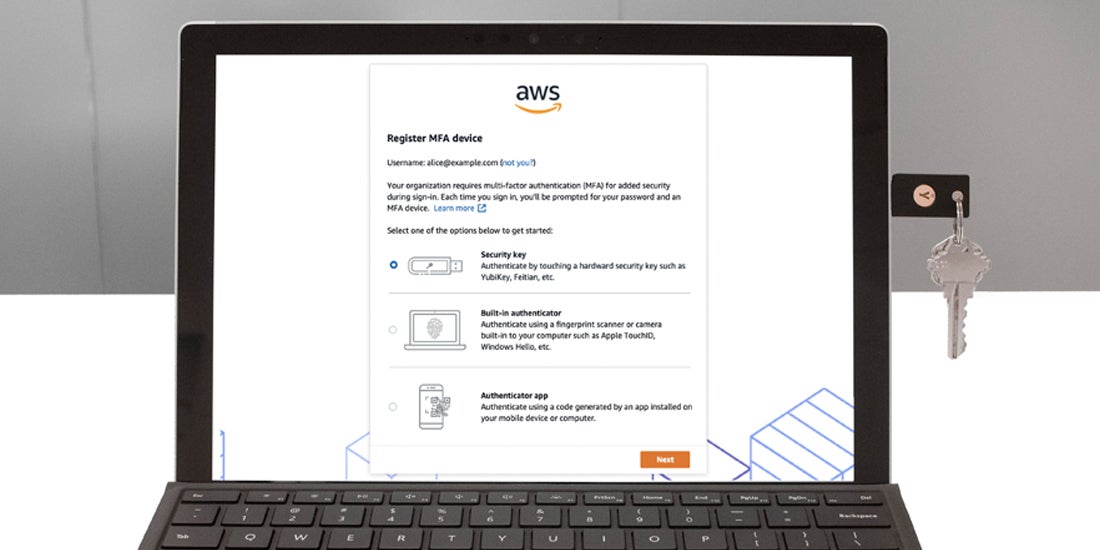
AWS Expands YubiKey Support with AWS SSO WebAuthn Integration Another win for FIDO at the heels of its first industry conference, Authenticate 2020. AWS Single Sign-On (SSO) has introduced native WebAuthn support to secure user access to AWS accounts and business applications using strong, FIDO-based multi-factor authentication (MFA) with YubiKeys. Broader choice of authentication methods by AWS SSO is a win for modern authentication that has historically […] Read more