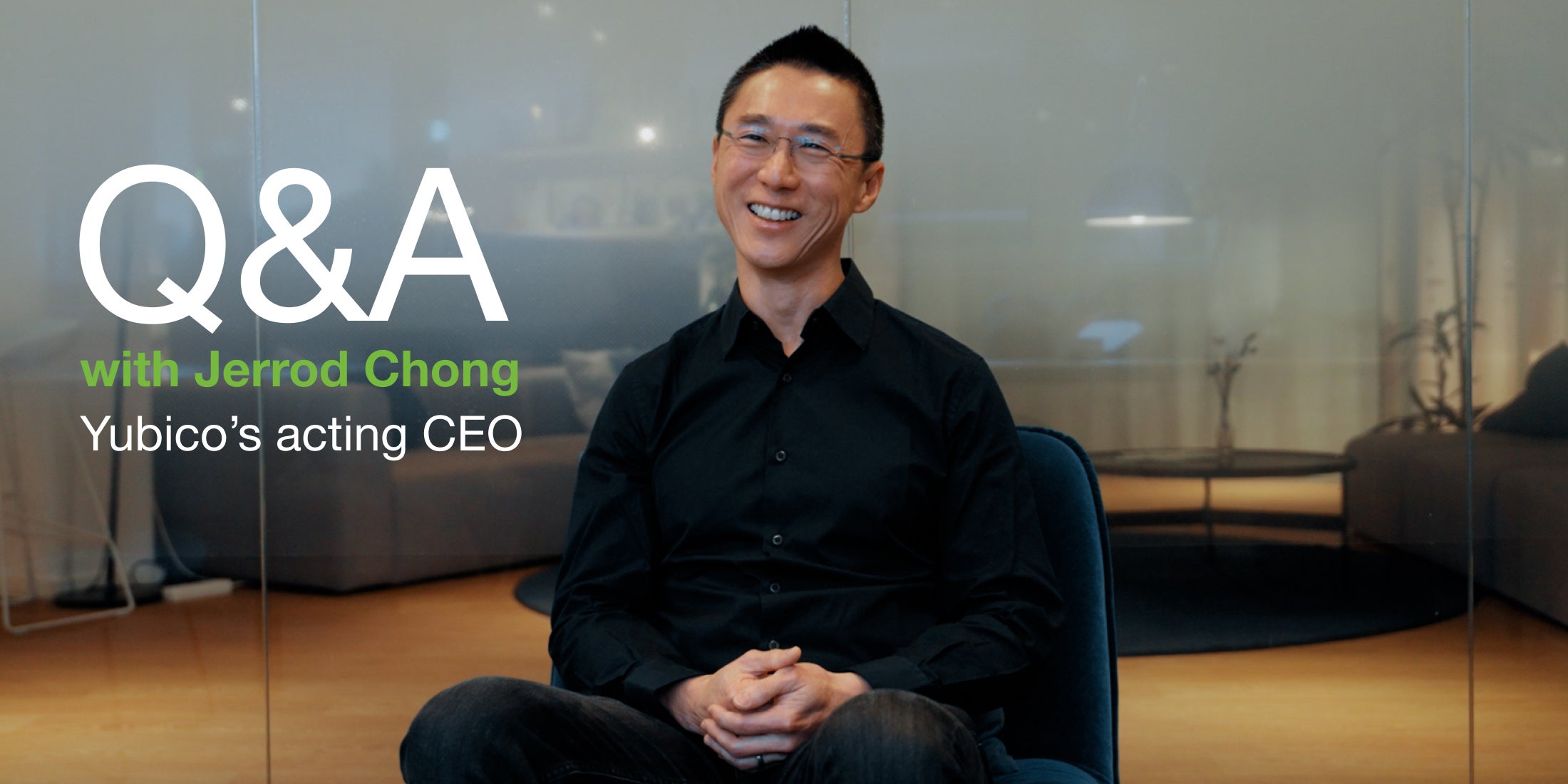
After more than 12 years at Yubico – most recently serving as president and COO – Jerrod Chong recently stepped into the role of Yubico’s acting CEO as the company enters its most exciting phase yet. Having worked across every facet of the business and the wider identity ecosystem, Jerrod is passionate in realizing Yubico’s mission to secure the internet for all.
Looking ahead to an exciting year ahead, Jerrod is incredibly enthusiastic about leading the charge as Yubico continues expanding its reach to secure digital identities globally on the path toward a passwordless, phishing-resistant future. While the company remains laser-focused on executing on its roadmap and navigating an increasingly complex world of evolving cyber threat landscape, Jerrod is equally committed to fostering the culture and momentum to keep Yubico at the forefront of modern authentication and expand into protecting digital identities for all.
To go beyond the strategy and the milestones, we sat down with Yubico’s new leader to discuss his personal journey, his vision for Yubico’s future, and what interests drive him outside of the office when he’s not leading a global cybersecurity company.
What excites you most about leading Yubico as acting CEO?
What drew me to Yubico is still what keeps me here today: the mission to protect everyone online. I learned during the very early days of Yubico that the passion, drive and mission of what we’re all collectively doing is what drives the company and our culture. It still does to this day, and will continue to do so in the future.
So, I really felt that was a personal calling for me – truly believing in the mission of what we do at Yubico to help everyone, including people that many think may not be relevant in the wide economy of the Internet. This includes vulnerable groups of people like journalists or dissidents – they are fighting every day for our freedom and our way of life around the world. These things are really important to me, and what I look forward to making an impact on every day.
Another exciting thing for me is the passion and excitement our customers have for Yubico and YubiKeys. They have laid the foundation of everything we do to this point, and give us the opportunity to grow the business based on their feedback and needs in an evolving landscape.
When I started at Yubico 12 years ago, a lot of the companies that we worked with are still companies today – and that’s just incredible when you have customers that follow you for more than a decade and beyond. I think what drives me is that we can do so much more to help our current and future customers navigate some of the biggest cybersecurity challenges that we see today, especially with a rapid increase in fraud and fake identities online – as well as new threats like generative and agentic AI-powered phishing attacks.
Can you tell us a little about yourself, including how you got into cybersecurity?
Well, I come from many different backgrounds that all melt together. I grew up in Singapore and studied there for close to 18 years. Then I did National service, which is what you have to do in Singapore. After I did National service, I moved to the U.S. for my University – and that’s when I learned about technology as a major in electrical and computer engineering.
The interesting thing is that was the beginning of the “dot com era,” and so I joined a “dot com” company when I left University and the bubble burst shortly after. One of the things that happened after that burst was that many companies around at that time were in cybersecurity – and I actually joined my first Swedish company back in 2000. It was more in data encryption, including protecting data on a hard drive. But ever since then, I’ve been in cybersecurity, and obviously Yubico is my second Swedish company.
What are the biggest opportunities for Yubico?
Governments around the world are now saying individuals and organizations must use phishing-resistant authentication like WebAuthn/FIDO and passkeys, and that is something I’m proud to say that Yubico had a big role in starting and leading the charge on to this day. Now that FIDO passkeys are in a mature state, there are of course still many things that still need to be done to make the user experience better globally. 90% of that is done, but now it gives us the ability to expand the scope of protecting all the users on the Internet in terms of the identity side. We’re now seeing attackers know that passkeys are being adopted at scale, and are looking for other vectors to attack outside of strong authentication via phishing attacks.
I also think there is a great opportunity for us to drive for more change in the way that we look at the identity lifecycle, including account recovery and onboarding. Companies are now looking to hire someone that they don’t know very well – which opens the door to hiring fake identities and nation state attacks.
As this threat continues to grow, onboarding and recovery become the weakest links for the identity lifecycle. For example, if you don’t know who someone is and you then give them a strong authentication credential, you just give the attackers the strongest authentication available. So, we really need to solve this as a cyber community – and this starts with a big ecosystem help from the SIROS Foundation and Yubico, who will be working on some big identity standards together to tackle these challenges moving forward.
What was your very first job and what’s one lesson from it?
One of my early jobs was working as an intern at a consulting company. I remember getting told, “The title to your PowerPoint better be relevant – otherwise, don’t bother presenting anything.” This taught me to always be clear and concise in my messages, and being sure that what I’m presenting is relevant to the intended audience.
Another lesson I learned was focused on security and people loving security. I think there’s a huge disconnection between people assuming every time you have to do anything that is secure it’s going to be difficult and painful, and nobody loves doing it. I think I really believe that you can love security like loving Yubico, and the goal and what we do, which is security.
What is one habit or routine that you rely on to stay grounded and focused?
I think grounding is really thinking about really all the struggles that everyone has seen around to just live who they want to be. We see this every day and everywhere, and I think the grounding is just opening your eyes and you will see that it’s hard to live in the world sometimes. That keeps me going.
Is there a mistake that you made earlier in your life or career that you’re grateful for now that it happened?
Don’t underestimate one’s own capabilities. It can be easy to doubt yourself, and I think in the early days, I had many challenges of doubting myself. I think you need to know yourself to then be able to choose yourself. So I think those early lessons of not knowing myself gave me a lot of hesitation – so I’m very grateful for those mistakes that I made.
Is there a book or podcast that you would recommend to people outside cybersecurity?
I listen a lot to podcasts about people talking about life experiences. There’s a podcast on NPR, which is National Public Radio in the US, and it’s about people talking about their life experiences. It’s very humorous, but it’s always a life learning experience that each of these speakers talk about. So I love that, about just enriching yourself through other people’s experiences.
If you were stranded on a desert island, who is the one person you would bring and what’s the one object you take with you?
That’s always a tough question – it’s like asking me who my favorite child is. I would say that one person would be my mom. I think she really brings a lot of sensibility to how I look at life, and that grounding and the ‘nagging’ is what got me where I am today. The object I would bring would be a picture of my family.
Is there any small ordinary thing that improves your everyday life?
I find that having time to think through exercise is really important for me – and it could be anything. It could just be something like walking or just not being in front of a computer for a bit. That really helps with cleansing. We live in a world where everything is very digital and, but all it takes is to look up to the sky and then your perspective changes a little bit in terms of how tiny you are in this grand universe of things.